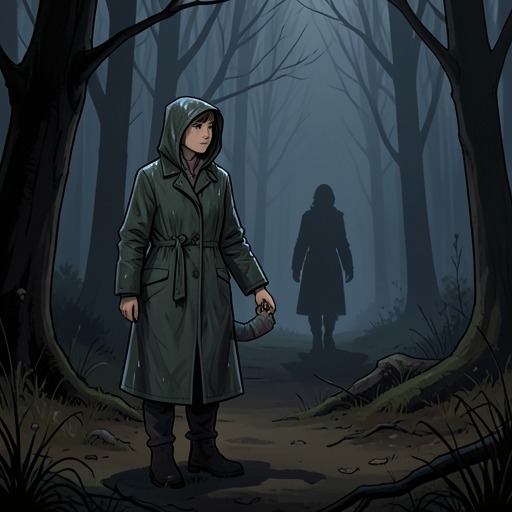
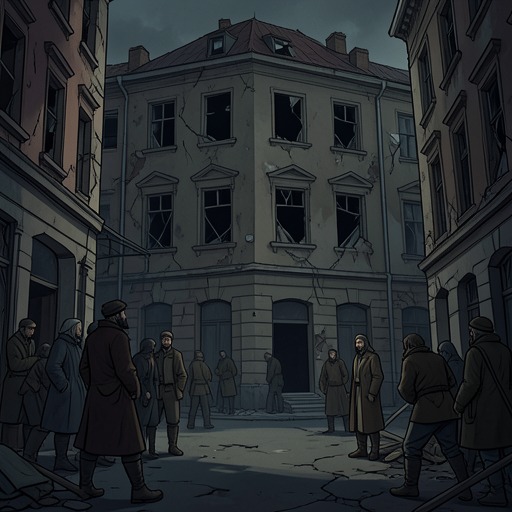
Shelter classified advertisement in newspaper
Bird BoxThe newspaper classified ad offers a refuge in Riverbridge to strangers as reports of the catastrophe mount. For Malorie, it becomes more than a notice: first a fragile possibility glimpsed in print, then the reason she leaves her home, and finally the words by which she asks the people inside to admit her while she keeps her eyes closed.
Appearance and Promise
On the morning when the front page announces the growing number of incidents with the stark headline “ANOTHER ONE,” Malorie turns the newspaper over and finds the classified. It says that a home in Riverbridge is opening its doors to strangers, describing itself as a safe house and a refuge, a hoped-for sanctuary amid the daily worsening news. The notice does not explain what is happening or promise that the house is secure; its force lies in offering a place and a human invitation when reliable public knowledge is disappearing.
Its contrast with the front page is important. “ANOTHER ONE” records the spreading crisis without giving Malorie a way to act, while the modest advertisement supplies a concrete destination. Outside, a neighbor’s door opens and quickly shuts; inside, Shannon covers a window with a blanket. Between those signs of fear, the classified represents a different response: someone has chosen to open a home to people they do not know.
From Print to Decision
Malorie initially wants to drive north to the Upper Peninsula, but Shannon refuses, judging a long journey too dangerous. The outside world is closing down: official instructions tell people to lock doors, cover windows, and not look outside, while the news offers no explanation for the violence and suicides associated with the Problem. In that setting, the advertisement is not an easy answer. It is a remembered alternative that can become useful only after the household’s immediate protection fails.
After Shannon dies, Malorie is alone and recognizes that she needs safety and must find a way to leave. She searches a stack of newspapers kept under the kitchen sink, turning each one over to inspect its back page. Finding the Riverbridge listing again, she reads it repeatedly and falls to her knees clutching the paper. The destination is only twenty minutes away. With her child to protect, she decides that the advertised house is the best available chance to reach safety.
The Notice Becomes an Appeal
At the house, Malorie cannot simply present the advertisement as proof that she will be welcomed. She calls out from the empty street that she has read the ad in the paper, but the people inside ask who she is and where she has come from. She explains that she has driven from Westcourt and says that she kept her eyes as closed as she could. From within, she hears low voices debating whether to let her in.
Her next appeal joins the notice’s promise to the rules of survival: she insists that she has seen nothing, swears that she is safe, and pleads with the household to admit her. A man tells her to keep her eyes closed and promises that the door will open so she can come inside quickly. The ad has brought her to the threshold, but it cannot remove the danger or the residents’ uncertainty. Entry depends on her demonstrating that she understands the danger and will obey the protective conditions.
A Small Document in a Failing Information System
The classified belongs to a brief period in which printed news still circulates even as the systems around it fail. By the time Malorie reaches the communal house, Tom explains that the Internet is down, the cell phones have stopped working, and no mail or newspapers are arriving. The landline and electricity still function because of the local hydroelectric plant, but their continued availability is uncertain; water must be drawn from a well, and daily tasks are done blindfolded. The newspaper notice thus records a remaining channel of contact just before newspapers themselves cease to reach the household.
Its significance is practical rather than magical. The advertisement cannot establish whether the hosts will be trustworthy, guarantee that the house will remain safe, or tell Malorie how the disaster began. It does, however, preserve a specific human offer in a world where public instructions are limited to hiding and not looking. Malorie finds it, acts on it, and invokes it aloud. The printed promise becomes consequential through that sequence: a back-page notice gives her a destination, and her repeated reference to it helps carry her from isolation to the guarded interior of the house.